
Brute-force attacks are a serious threat
Brute force bots attempt to gain unauthorized access to accounts and systems by automatically trying countless login combinations.
CAPTCHAs prevent brute-force attacks
A modern CAPTCHA like Friendly Captcha blocks automated login attempts while remaining fully invisible, privacy compliant, and accessible for all.
Preventing brute force attacks with a multi-layered strategy
Prevent brute force attacks by monitoring login activity, blocking suspicious IPs, and using proof-of-work CAPTCHAs, such as Friendly Captcha.
Friendly Captcha prevents brute force attacks
Friendly Captcha efficiently and invisibly defends against brute force attacks by acting as an additional security layer to safeguard user accounts. Try out now ›
A brute force attack is a method of cyber attack that uses automated tools to guess user login credentials, encryption keys, or other sensitive data through exhaustive trial and error. By systematically testing countless combinations of usernames and user passwords, attackers aim to gain unauthorized access to accounts, systems, networks, directories, or websites.
Despite being one of the oldest forms of hacking, brute force attacks remain highly effective. They are becoming less and less time-consuming with the development of artificial intelligence. Their simplicity and persistence make them a continued threat in the world of cybersecurity.
One of the most efficient way to prevent brute force attacks is to enable a CAPTCHA service on your website or web applications.
Different Types of Brute Force Attacks and Prevention Techniques
| Type of attack | Description | Impact | Prevention methods: How to block brute force attacks |
|---|---|---|---|
|
Simple Brute Force Attack |
Tries all possible combinations of characters until the correct password is found. |
Time-consuming but can crack weak, short or same passwords. |
Use long, complex passwords and implement account lockout policies. |
|
Dictionary Attack |
Uses a predefined list of common words or common passwords to guess login credentials. |
Quickly cracks passwords based on common terms or weak user choices. |
Enforce strong password policies (password length, special characters, upper and lowercase letters, password manager); avoid dictionary words. |
|
Hybrid Brute Force Attack / Hybrid attack |
Combines dictionary words with numbers or symbols to expand guessing attempts. |
More effective than dictionary alone; targets slightly stronger passwords. |
Encourage use of random passwords with no predictable patterns for user credentials. |
|
Credential Stuffing |
Uses same credentials such as leaked username-password combinations from data breaches on multiple sites. |
High success rate if users reuse known passwords across multiple accounts or use the same username. |
Enable multi-factor authentication (MFA) and promote unique passwords and multiple usernames.
Read our guide Credential Stuffing Prevention for more insights. |
|
Password Spraying |
Tries a few commonly used passwords across many accounts to avoid detection. |
Can bypass lockout policies; compromises many accounts slowly. |
Monitor login attempts, limit failed logins and unsuccessful login attempts, and alert for suspicious activity. |
|
Rainbow tables attacks |
Uses a precomputed table of hash values mapped to their original plaintext passwords to crack password hashes. |
Can compromise large numbers of reused or weak passwords. |
Enforce password policies, use strong, slow hashing algorithms and use salted hashing. |
How CAPTCHAs Help Prevent Brute Force Attacks
Modern CAPTCHAs are especially helpful in mitigating automated brute force attacks by adding a human and/or technical verification layer.
CAPTCHAs prevent bots from repeatedly submitting login forms.
CAPTCHAs also prevent automated tools from cycling through word lists.
CAPTCHAs disrupt pattern-based login attempts.
CAPTCHAs slow down bots.
CAPTCHAs help to limit high-volume, low-frequency attempts.
When used alongside powerful safeguards such as multi-factor authentication (MFA), CAPTCHAs become an essential line of cyber protection.
How To Prevent Brute Force Attacks with Friendly Captcha
Distinguishing between legitimate users and automated bots attempting to gain unauthorized access is key to preventing brute force attacks. A next-gen CAPTCHA like Friendly Captcha plays a key role in this defense mechanism by blocking automated login attempts and safeguarding user accounts.
Traditional CAPTCHAs, such as reCAPTCHA and hCAPTCHA, often rely on user interaction, such as identifying images or typing distorted text, which can negatively impact accessibility and user experience. These methods are not always WCAG-compliant and may exclude users with disabilities.
Friendly Captcha offers a modern alternative. It provides robust protection against brute force attacks without disrupting the user experience. Using cryptographic proof-of-work and risk-based scoring entirely in the background, Friendly Captcha effectively stops bots while remaining invisible to users. It is fully compliant with major privacy and accessibility standards, making it an ideal choice for secure, user-friendly bot protection and mitigation.
Why Is Friendly Captcha the Most Modern Solution for Preventing Brute Force Attacks
Proof-of-work CAPTCHAs like Friendly Captcha require bots to solve computational puzzles with each request, introducing intentional delays for attackers. This significantly increases the time and resources needed for every attempt, making large-scale brute force attacks costly and inefficient. Since each request demands a solved puzzle, the attack rate is naturally throttled – creating a built-in rate limiter without relying solely on conventional defenses like IP blocking.
While blocking specific IPs or regions can quickly disrupt brute force attacks, this approach risks excluding genuine users. In contrast, Friendly Captcha uses an advanced risk signaling system that enables more nuanced decisions. Instead of a simple allow-or-block model that may lock out real users, it dynamically adjusts puzzle difficulty based on the perceived risk, offering a more balanced and adaptive solution.
How to Reverse a Brute Force Attack?
Technically, it is not possible to reverse traditional brute force attacks that have happened, because attackers gained access already. However, it is relatively easy to detect a brute force attack by:
checking logs for repeated, multiple login attempts or unusual traffic patterns.
looking for large requests to connection or authentication endpoints;
using security tools to flag suspicious IP addresses or unusual connection behavior.
🔎 Tool Insights
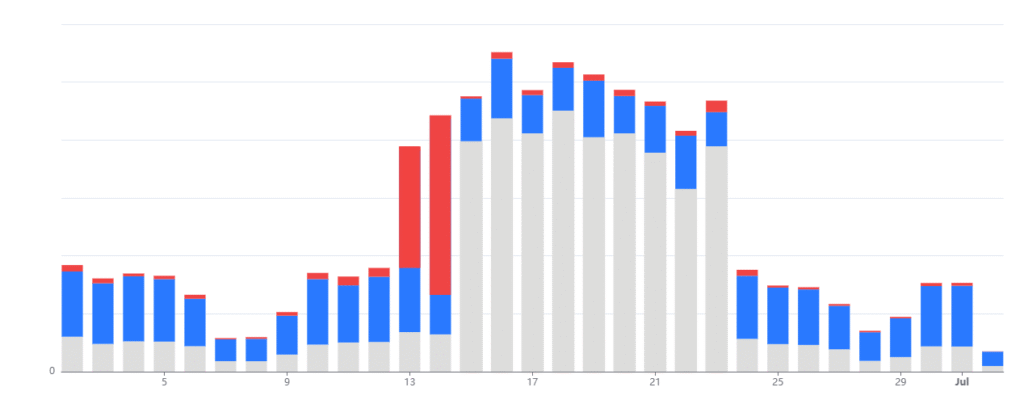
The Friendly Captcha dashboard shows how many login attempts have been made. If an abnormal spike appears, like on the screenshot, it is likely that your website is under a brute force attack.
How to Mitigate a Brute Force Attack?
If your accounts have been targeted by a brute force attack, you should take the following steps immediately:
Temporarily lock the affected accounts to prevent attackers to gain access again.
Enable CAPTCHA to protect against automated bots.
Set up rate limiting to restrict repeated login attempts from the same IP address. Modern proof-of-work CAPTCHAs play this role already.
Block IP addresses or suspicious geographic locations. Modern CAPTCHAs providers offer blocking options to deal with suspicious IP addresses.
After that, it is wise to force a password reset for any affected or high-risk accounts. You should also check for unauthorized access and/or unusual activity in user accounts. Finally, conduct an audit of your systems to detect any security breaches or data exfiltration.
Prevent Brute Force Attacks with Friendly Captcha
Although brute force attempts are persistent, they can be effectively prevented with the right measures.
The most effective way to prevent brute force attacks is to integrate a CAPTCHA service that does not disrupt the user experience, such as Friendly Captcha. CAPTCHAs are tests designed specifically to distinguish between humans and robots, and are therefore essential for preventing brute force attacks.
Friendly Captcha is at the forefront of newest CAPTCHA technology. It prioritizes usability, accessibility, and privacy without compromising on security. With Friendly Captcha, you can monitor login attempts in real-time in your dashboard so you notice immediately if bots try to access systems. Friendly Captcha is easy-to-use and compatible with most of web applications – check our integrations!
Choose privacy-respecting Friendly Captcha to ensure that security and usability go hand in hand. Try Friendly Captcha for yourself by watching the live demo or signing up for a free one-month trial.
FAQ
Brute-force attacks are a hacking method that use a trial-and-error approach to guess passwords, login credentials, or encryption keys. The attacker systematically and repeatedly tries different combinations of letters, numbers, and symbols until the correct one is found. While the concept is simple, modern attackers use sophisticated automated tools and botnets to execute millions or billions of attempts per second.
Use a modern CAPTCHA like Friendly Captcha that uses invisible proof-of-work for strong protection against automated brute force attacks.
Yes, brute-force attacks are very dangerous for individuals and organizations alike. While they may seem like a simple and unsophisticated hacking method, their simplicity, scalability, and persistence make them a serious and continuous cyber threat. With the help of automation and powerful hardware, attackers can execute millions of attempts, and the risk increases exponentially with the reuse of weak or compromised passwords. Use a CAPTCHA to effectively block bots from making repeated automated attempts. Modern, invisible CAPTCHAs, such as Friendly Captcha, do not frustrate users while still protecting against automated attacks.
The most effective way to protect against brute-force attacks is to implement a multi-layered security strategy, with Multi-Factor Authentication (MFA) in combination with a robust CAPTCHA as the most powerful defense. A layered approach prevents attackers from succeeding even if they compromise one security measure. Modern CAPTCHAs such as those from Friendly Captcha are crucial for blocking automated bots without frustrating legitimate users. They work with invisible challenges that run in the background, using a proof-of-work mechanism to distinguish humans from bots.
To stop brute-force attacks today, you need to implement a multi-layered security strategy, with a combination of Multi-Factor Authentication (MFA) and CAPTCHA. Relying on a single measure is no longer sufficient against modern, automated threats. Find a secure CAPTCHA service in Friendly Captcha. It is a good option as it is easy to implement, compatible with most systems, user-friendly, and privacy compliant.
No, brute-force attacks are generally illegal in nearly all jurisdictions, especially when conducted against systems you are not authorized to access. While the act of trying password combinations in itself isn’t criminal, the intent to gain unauthorized access to a computer system or network makes it a serious cybercrime. The legality hinges on the concept of unauthorized access.
Friendly Captcha helps to stop brute force attacks as a first layer of defense.
Yes, CAPTCHAs can effectively prevent brute-force attacks, but their effectiveness varies depending on the type of CAPTCHA and how it is implemented. CAPTCHAs are an essential part of a multi-layered security strategy to stop automated scripts from making repeated login attempts.
Solutions like Friendly Captcha use a cryptographic puzzle that the user’s device solves invisibly in the background. This is a minor task for a single human device but computationally intensive for a botnet, making brute-forcing costly and inefficient for attackers.
To find the best CAPTCHA for preventing brute-force attacks, it’s crucial to look beyond traditional visual puzzles and focus on modern, invisible solutions. These next-generation tools prioritize user experience while leveraging advanced techniques to stop automated bots. Here are the top options, compared by their effectiveness against brute-force attacks. Friendly Captcha is widely regarded as one of the most effective and user-friendly solutions specifically for preventing automated attacks on forms.
For the best balance of security and user experience, Friendly Captcha is a superior choice. Its use of invisible proof-of-work offers strong protection against automated brute-force attacks without disrupting the user flow or compromising privacy.
The best practice for preventing brute-force attacks is to implement a multi-layered security strategy, with Multi-Factor Authentication (MFA) and CAPTCHA. A combination of policies and technical controls is necessary to stop attacks at various points and protect against evolving threats.
Deploy modern, invisible CAPTCHAs that stop automated bots from even reaching your login forms without frustrating legitimate users. Use friction-reducing CAPTCHAs solutions like Friendly Captcha use invisible techniques, such as a proof-of-work mechanism, to differentiate humans from bots without requiring user interaction. The computational cost of solving a proof-of-work CAPTCHA like Friendly Captcha effectively acts as a rate limiter, making brute-force attacks less efficient.
 English
  German
  French
  Spanish
  Italian
  Portuguese